
Watch Spring Bar Guide — Sizes, Types & When to Replace
The spring bar is the spring-loaded pin that holds your strap between the lugs — and it is the single most common reason a new strap “won’t fit”. This guide covers the sizes that matter, the types, and when to replace them.
Rule of thumb: spring bar length equals your lug width (18/20/22mm). Diameter is the hidden trap — a 2.5mm bar will not enter a strap drilled for 1.8mm holes.
The two numbers on every spring bar
Length matches the lug gap: an 18mm watch takes an 18mm bar. Diameter is the thickness of the pin itself — and the source of most fitment frustration. A strap or end link is drilled for one diameter; force a thicker bar in and the strap holes stretch or tear.
Diameter: 1.8mm vs 2.5mm
Most aftermarket two-piece straps are drilled for 1.8mm bars — the de facto standard. Heavier 2.5mm “fat” bars ship on several dive watches (many Seiko divers leave the factory on fat bars) and on some bracelets. The two families do not interchange: a fat bar will not fit standard-drilled straps, and a standard bar in fat-bar end links sits loose.
Practical consequence: when you move a Seiko diver from its stock bracelet to an aftermarket strap, you usually swap to the strap’s included 1.8mm bars — or order a strap explicitly drilled for fat bars. When a product page says “use the original spring bars”, that is this exact issue talking.
Spring bars across our lines
| Line | Bar length | Diameter note |
|---|---|---|
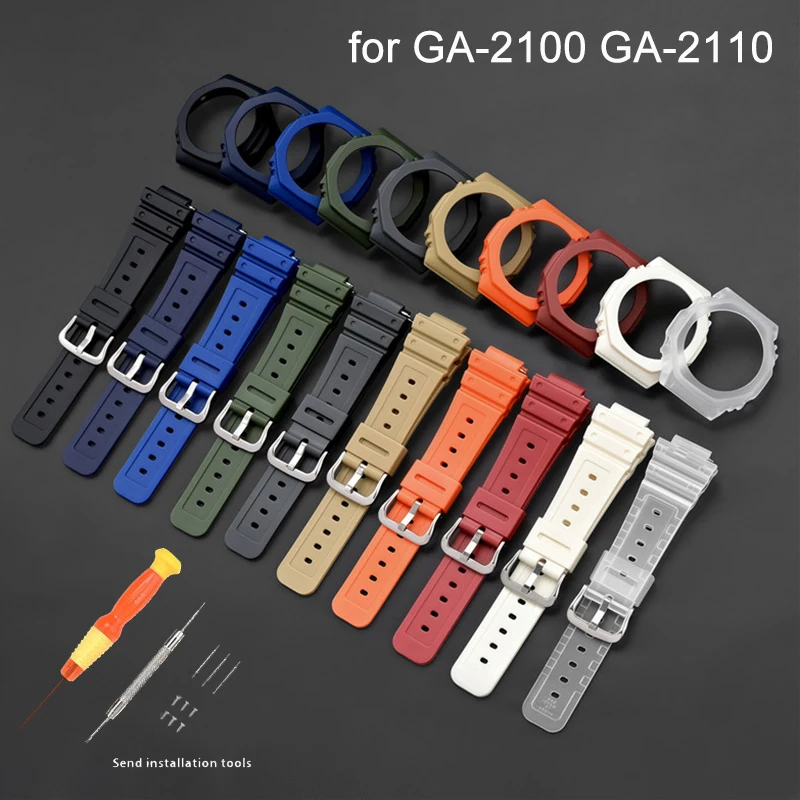
| GA-2100 with adapter | 22mm | Standard bars included with adapter sets |
| DW-5600 with adapter | 16mm | Standard bars included with adapter sets |
| F-91W / A158 / A168 | 18mm | Standard bars, direct fit |
| AE-1200 / AE-1300 | 18mm | Stock band is 21mm wide but mounts on 18mm bars |
| MDV-106 Duro | 22mm | Standard bars |
| Seiko SKX / SRPD | 22mm | Check fat-bar vs 1.8mm before ordering straps |
| Apple Watch | None | Slide-in slot, no spring bars |
Four types you will meet
- Double-shoulder — the standard; spring-tool removal from either side.
- Single-shoulder — one removal notch; common on bracelets.
- Quick-release — a pull-latch swaps straps in seconds, no tool. Slightly lighter duty: great on straps, skip it for heavy metal bracelets.
- Fat bars (2.5mm) — heavy-duty factory fitment on dive watches; match replacement straps accordingly.
When to replace
Replace a bar that is bent, has worn shoulders (the strap slides off too easily), or has rust spots. If you rotate straps often, keep a spare set per width — bars are consumables, and losing one mid-swap over a hard floor is a rite of passage.
Buying checklist
- Length = lug width. Diameter = whatever your strap or end link specifies (usually 1.8mm).
- Stainless steel, hardened; avoid unmarked mystery metal.
- Buy spares in the widths you actually use.
Width by model: see our lug width chart. Adapter bars: covered in the GA-2100 adapter install guide.
FAQ
Will a 2.5mm spring bar fit a strap drilled for 1.8mm?
No. Strap holes are sized to one diameter — forcing a fat bar stretches or tears them. Use the diameter the strap specifies.
How do I know which spring bar I have?
Measure the pin’s thickness with a caliper (or a drill-bit gauge), and remember length equals lug width. When in doubt, reuse the bars that came with the part.
Are quick-release spring bars weaker?
Slightly — the latch shoulder gives up a little strength. Fine for fabric, rubber and leather; for heavy bracelets use standard double-shoulder bars.
Aftermarket accessories. Not affiliated with Casio, Seiko or Apple. All trademarks belong to their owners.